


Food Banks & Charities
Food Banks, Charities & Community Centers
When food arrives, the clock starts — and a “good problem” can become urgent fast. BenchFoods dehydrators help food banks and community organisations extend donation windows, reduce pressure on refrigeration, and create shelf-stable ingredients that can be stored, moved, and used when they’re needed most.
This isn’t about turning donations into products. It’s about building a calmer system: less waste, less rush, and more predictable ingredients for everyday meal programs and emergency response.
BenchFoods units are built for repeatable results: stainless-steel construction, even airflow across trays, and straightforward controls that teams can train on quickly. When outcomes are consistent, planning gets easier — and your operation stays reliable even when donations arrive in waves.
Extend donation windows:
Stabilise surplus produce and short-dated items before they spoil. Dry them into labelled, easy-to-store components that stay useful longer.
Make home support practical:
Turn volunteer energy into ready ingredients — fruit, vegetables, herbs, and meal components — without turning a kitchen into a production line.
Build emergency-ready reserves:
Create lightweight, long-life food components that travel well and support response kits when refrigeration or power is limited.
Reduce waste, amplify impact:
Use more of what you receive and show a clearer donor story: more of their contribution stayed in circulation.
Food Banks at Home — Domestic
Preserve what would expire first:
If you’re a home supporter, volunteer, or community pantry organiser, you know the “donation rush” problem: a lot arrives at once, and some of it won’t make it through the week. A domestic dehydrator lets you stabilise the items with the shortest window — sliced fruit and vegetables, herbs, soup bases, and simple meal components — into organised, labelled ingredients you can store and donate when timing makes sense.
Simple storage, calmer distribution:
When food is properly dried and packaged, it takes up less space and can be stored for long periods in a compact, predictable format. That means less dependence on limited fridge/freezer space and more control over rotation. Instead of sorting “what must be used today,” you can build tidy categories that make meal prep easier for the people running programs.
People Are Talking About Benchfoods
Tolstoy goes here...
Commercial Range
View All-


 Most PopularUp to 40% off
Premium Commercial Dehydrators
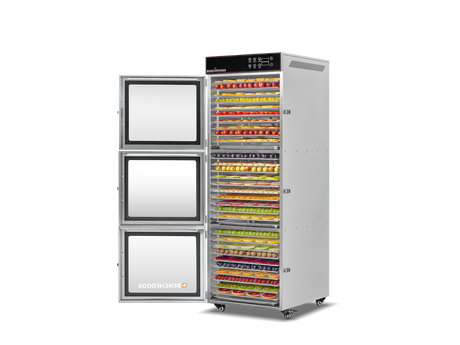
1 Zone / 16 Tray / 2.56m² Tray Area
From€839 EURWas€1.395Save€556Unit price /Unavailable -
 Up to 39% off
Premium Commercial Dehydrators
3 Zone / 30 Tray / 4.8m² Tray Area
From€2.099 EURWas€3.449Save€1.350Unit price /Unavailable -

 Up to 42% off
Premium Commercial Dehydrators
2 Zone - Vertical / 32 Tray / 5.12m² Tray Area
From€2.189 EURWas€3.799Save€1.610Unit price /Unavailable -

 Up to 24% off
Premium Commercial Dehydrators
2 Zone - Horizontal / 32 Tray / 5.12m² Tray Area
From€2.889 EURWas€3.799Save€910Unit price /Unavailable -


 Up to 37% off
Premium Commercial Dehydrators
3 Zone / 60 Tray / 9.6m² Tray Area
From€4.595 EURWas€7.289Save€2.694Unit price /Unavailable -


 Large CapacityUp to 37% off
Premium Commercial Dehydrators
2 Zone / 28 Tray / 11.90m² Tray Area
From€5.829 EURWas€9.295Save€3.466Unit price /Unavailable -

 New Product LaunchSALE 40% Off
Premium Commercial Dehydrators
1 Zone / 16 Tray / 2.56m² Tray Area - Biltong Bundle
NOW€909 EURWas€1.510Save€601Unit price /Unavailable -

 SALE 39% Off
Premium Commercial Dehydrators
3 Zone / 30 Tray / 4.8m² Tray Area - Biltong Bundle
NOW€2.219 EURWas€3.624Save€1.405Unit price /Unavailable


Community Programs & Kitchens — Commercial
Operational rhythm that volunteers can follow:
Community centres, soup kitchens, shelters, and small charities run on people-power — and people change. The strongest programs win by building simple systems: clear prep lanes, consistent output, and ingredients that behave the same way every time. A commercial dehydrator helps you convert inconsistent donations into repeatable components that speed up service and reduce last-minute scramble.
Plan menus with fewer surprises:
When you can stabilise donations into standard components, meal planning becomes easier. You can batch prep when volunteers are available, store ingredients neatly, and pull what you need for consistent meals — without relying on perfect delivery timing or constant refrigeration space.
Build a simple “dehydration lane”:
Even a small team can run a predictable workflow: sort → prep → dry → cool → label → store. Once the routine is in place, training new volunteers becomes easier, quality becomes more consistent, and the kitchen feels calmer during peak periods.
Turn consistency into capacity:
Commercial dehydrators are especially valuable when you’re feeding people daily. Instead of adapting the menu to whatever is most urgent, you can build a stable pantry of ingredients that supports your regular meal plan — with less waste and less last-minute substitution.
Education that builds dignity (and reduces repeat need):
Food support is about more than meals — it’s about capability and confidence. Dehydration fits beautifully into practical workshops on preservation, budgeting, and “use what you have” cooking. It strengthens community skills, improves self-sufficiency, and positions your organisation as a place that doesn’t just distribute support — it teaches it.

How The Mustard Seed Is Fighting Food Waste in Victoria, BC
The Mustard Seed in Victoria, BC is doing incredible work rescuing food, supporting the community and finding better ways to make good food go further.
Through its Food Security Distribution Centre, thousands of pounds of food are rescued every weekday and redistributed across Greater Victoria.
BenchFoods is proud to play a small part in that story, with dehydration helping create another option for suitable surplus produce - from extending shelf life to creating alternative products such as dried fruit and fruit leather.
This story is really about the people behind The Mustard Seed: the staff, volunteers, donors and community partners working every day to reduce food waste and support people experiencing food insecurity.
Large-Scale Food Banks & Relief Logistics — Industrial
Emergency-ready reserves for uncertain conditions:
At scale, the mission is logistics: weight, storage footprint, safety, and stability. Industrial dehydration helps turn surplus and short-window donations into shelf-stable ingredients that can be staged, transported, and deployed across partner networks — especially when cold storage is limited or conditions change quickly.
Build emergency-ready reserves:
Dehydrated ingredients are lightweight, space-efficient, and easier to move across a network of partners. They support relief packs, partner allocations, and consistent meal programs — without forcing everything through a tight “use-by” window.
Throughput + consistency when volume spikes:
When you’re processing volume, efficiency is impact. A high-capacity dehydration lane can create predictable output from unpredictable inputs — helping you plan distributions, standardise partner packs, and smooth supply volatility.
Treat drying as a system:
Industrial teams benefit most when dehydration is treated like an SOP: clear inputs, repeatable cycles, labelled output, and clean hand-offs to storage and distribution. You can also standardise simple checks (cool, dry, pack, label) so the output stays consistent across shifts.
The result is fewer losses, better allocation, and a calmer operation when pressure rises — especially during seasonal surges, large donation events, or disaster response periods.
Industrial Range
View All-

 Up to 24% off
High-Capacity Industrial Dehydrators
1 Trolley / 30 - 60 Tray / 8.8 - 17.7m² Total tray area
From€26.595 EURWas€34.995Save€8.400Unit price /Unavailable -

 Up to 28% off
High-Capacity Industrial Dehydrators
2 Trolley / 60 - 120 Tray / 17.7 - 35.3m² Total tray area
From€37.595 EURWas€51.995Save€14.400Unit price /Unavailable -

 Up to 34% off
High-Capacity Industrial Dehydrators
4 Trolley / 120 - 240 Tray / 35.3 - 70.7m² Total tray area
From€56.895 EURWas€85.995Save€29.100Unit price /Unavailable -

 Up to 36% off
High-Capacity Industrial Dehydrators
8 Trolley / 240 - 480 Tray / 70.7 - 141.3m² Total tray area
From€91.995 EURWas€142.995Save€51.000Unit price /Unavailable -

 Up to 32% off
High-Capacity Industrial Dehydrators
10 Trolley / 300 - 600 Tray / 88.3 - 176.6m² Total tray area
From€119.995 EURWas€175.995Save€56.000Unit price /Unavailable -

-

-


Relating Partners in Food Banks & Charities
From environmental solutions to pet treats, we are continually amazed with the diverse applications of our dehydrators.


Reducing Waste, Respecting Every Donation
Waste reduction:
Food waste isn’t just a cost — it’s a climate and resource issue. When edible food ends up in landfill, it can generate methane. Extending donation windows through dehydration helps you rescue more of what you receive and keep more good food in circulation.
It’s also a trust signal: donors and partners can see that surplus is treated carefully, not hurried through a system that forces unnecessary loss.
Education that sticks:
Sustainability works best when it becomes habit. When donors, volunteers, and households learn simple, repeatable ways to extend food life, the whole local food system becomes more resilient — and more food makes it to the people it’s intended for.

Make Every Donation Go Further
BenchFoods dehydrators support food banks and community organisations at every scale — from home supporters to commercial kitchens to large distribution networks. When you can extend donation windows and reduce waste, you can plan with confidence and serve more consistently.
Contact us to choose the right dehydration setup for your program — and build a system that keeps more good food moving to the people who need it.
FAQs
How does dehydration actually help with the "donation rush" problem?
It stabilises whatever has the shortest shelf window first, sliced fruit, vegetables, herbs, and meal components, turning them into labelled, shelf-stable ingredients instead of items racing the clock before they spoil.
What does a simple dehydration workflow look like for a small charity or community kitchen?
Sort, prep, dry, cool, label, store. Once that routine's in place, training new volunteers gets easier and output stays consistent even as people change.
Does this only help with fresh produce, or other donated food too?
Fruit, vegetables, herbs, and meal components can all go through the same process, turning inconsistent donations into standard components that speed up meal planning and service.
How does dehydration reduce pressure on limited fridge or freezer space?
Dried, properly packaged food takes up far less space and doesn't depend on cold storage, so rotation becomes easier and less food is lost to "what has to be used today" pressure.
What's the advantage at large scale, across food bank networks?
Dehydrated ingredients are lightweight and space-efficient, making them easier to stage, transport, and deploy across partner networks, especially useful when cold storage is limited or conditions change quickly.
Does this create any value beyond just preserving food?
Yes, it supports practical workshops on preservation, budgeting, and "use what you have" cooking, building community skills and self-sufficiency, not just distributing supplies.


